Palladyne AI is a Salt Lake-based robotics software and defense tech company. It was previously known as Sarcos Robotics and was started in 1983 out of the University of Utah. Palladyne was purchased in 2007 by Raytheon and then split to become its own company again in 2015. Up until 2024, Palladyne was a robotics hardware company. However, they released an MVP of their Palladyne IQ software product in May of 2024 and conducted a full pivot into a robotics software company. On November 17, 2025, they announced strategic acquisitions of two companies: GuideTech and Crucis. With these acquisitions, Palladyne gained manufacturing and engineering capabilities, and split the company into two divisions: Palladyne Commercial and Palladyne Defense.
Palladyne Commercial has two products: Palladyne IQ and Palladyne Pilot.
- Palladyne IQ is an AI software that is designed to be the brains of an industrial robot. It is designed to be "hardware agnostic" meaning that it will work with most industrial robots that are currently being sold. Palladyne IQ's potential applications include product assembly, heavy material handling, surface preparation, and more.
- Palladyne Pilot is an AI software that is designed to connect drones together to form a network of "autonomous collaborative assets."
The Palladyne software systems differ from the industry norm with AI that is more compact, tailored to specific solutions, and uses less training data. Their systems perform calculations on the edge, meaning they don't need to maintain a constant connection to the cloud.
Palladyne Defense has the following software and hardware products:
- SwarmOS is a re-branded version of Palladyne Pilot that has additional defense-specific capabilities.
- BRAIN X2 is a flight computer for UAVs (drones). Due to its modular and lightweight design, they can offer it at a fraction of the cost of comparable systems. According to an investor presentation on Palladyne's website, BRAIN is less than half a pound and costs $6k, while the systems used in conventional avioinics weigh around 5 pounds and cost over $50k.
- Gremlin-X(fka Project Banshee) is a loitering munition. One of Gremlin's advantages over the current comparison is in cost. Gremlin's cost per target effect is under $1k, while the current comparison's cost per target effect is estimated to be $58k. This is because Gremlin-X can complete 30+ missions and the current comparison can only complete 1.
- Project SwarmStrike is a cruise-class autonomous missile system. It costs $150k, compared to the $3M cost for current cruise-class missiles.
Palladyne has been busy in 2026 so far. During the year, they have announced the following:
- The commercial availability of Palladyne IQ 2.0.
- A new GuideTech contract with Portal Space Systems to support the development of a new spacecraft platform.
- A new contract with the Air Force Research Laboratory using SwarmOS for a project called HANGTIME (Hierarchical Adaptive Networked Game-Theoretic Integration of Multiple Echelons).
- A ~$1 million contract with a major prime defense contractor to deliver a subsystem that supports missile propulsion in an existing US missile program.
- The first flight of IntelliSwarm, which is SwarmOS integrated into a BRAIN X2 flight computer
- A new GuideTech contract with the US Navy to develop a new, low-cost missile.
- A patent that protects a proprietary intelligence framework used for target recognition, autonomous path planning, and behavior prediction on the edge.
- A new partnership with Israel Aerial Industries (IAI), an Israeli, government-owned aerospace and defense company. Under the agreement, Palladyne will manufacture, "Americanize", and market to the US government, IAI's loitering munitions systems.
In 2H 2025, Palladyne agreed to a partnership with Draganfly to integrate Palladyne Pilot into Draganfly's UAV platforms, secured a patent for swarming technology, and consummated the previously mentioned acquisitions of GuideTech and Crucis.
Palladyne seems to be leaning more into the defense side of their business. Evidence for this includes the November acquisitions and the fact that the updates listed above for this year all relate to Palladyne Defense. The company has repeatedly emphasized that it is adapting its strategy to meet some of the initiatives of the Department of War. In a November investor conference call, CEO Ben Wolff mentioned the Replicator Initiative, which aims to use "all-domain attributable autonomous systems, which are less expensive, put fewer people in the line of fire, and can be changed, updated, or improved with substantially shorter lead times." In a more recent conference call on June 9, he said that Palladyne is "pursuing the development of differentiated UAV, missile, and loitering munition systems that address specific capability gaps in the Department of War's arsenal." The recent partnership made with IAI seems to be a big step for the company. IAI is the biggest defense company in Israel and one of the top in the world. Palladyne will now have the exclusive rights to develop and manufacture IAI's loitering munitions in the US. Palladyne plans to "Americanize" the systems to fit the Department of War's goals and estimates a 12-18-month timeframe for this process.
While the strength of the defense side of the business is apparent, the commercial side remains unproven. Palladyne IQ was released in October 2024 but they only recently gained their first customer for the product. They have maintained in their reporting that the sales cycle for Palladyne IQ is expected to be 12 to 18 months, or even longer. They have reached that timetable since the product has veen commercially available, so I think investors will be expecting to see more customers being picked up in coming quarters. This will ultimately come down to factors such as competition, macroeconomics, and product performance. A former member of the Board of Directors, Matt Muta, was appointed earlier this year to be the President of Palladyne Commercial. He will be focusing on "building a scalable commercial engine and driving enterprise adoption". For the company to reach its full potential, it will need to see success from both the defense and commercial sides of the business.
Although Palladyne is 42 years old, I analyze them like an early-stage company because of how significantly they pivoted their business model a couple years ago. A company in this stage requires a different type of financial analysis. The primary factors I look at are revenue, balance sheet health, and cash burn. Revenue trends show me the growth of the business, and the other two tell me whether the company can survive without too much shareholder dilution if they aren't able to immediately generate earnings. Palladyne has good balance sheet health currently, with high liquidity and low leverage. They ended Q1 2026 with cash and marketable securities of $44 million, and expect a cash usage rate of $8-9 million per quarter during 2026. At this pace, they could survive through 2026 and a little beyond without needing to seek additional financing. At the end of Q1, Palladyne had no long-term debt on their balance sheet, and their financial leverage (assets/shareholders' equity) was 1.3x. High liquidity and low leverage will provide Palladyne with some breathing room to execute their vision without running out of money. They ended 2025 with revenue of $5 million and set 2026 revenue expectations at $24-27 million, noting that much of the revenue in these assumptions comes from the November acquisitions. Revenue for Q1 26 came in at just over $3.5 million, which is below the guidance pace, but they did say that they expect 2026 revenue to be back-end-weighted and reiterated the $24-27 million guidance range. In the June 9 conference call, Ben Wolff said the following about the company's expectations going forward: "We have been describing our execution path in three stages: proving and integrating today, converting to larger revenue-generating contracts in 2027, and scaling from 2028 onward."
See the below valuation metrics for Palladyne, as of close on 6/8/26:
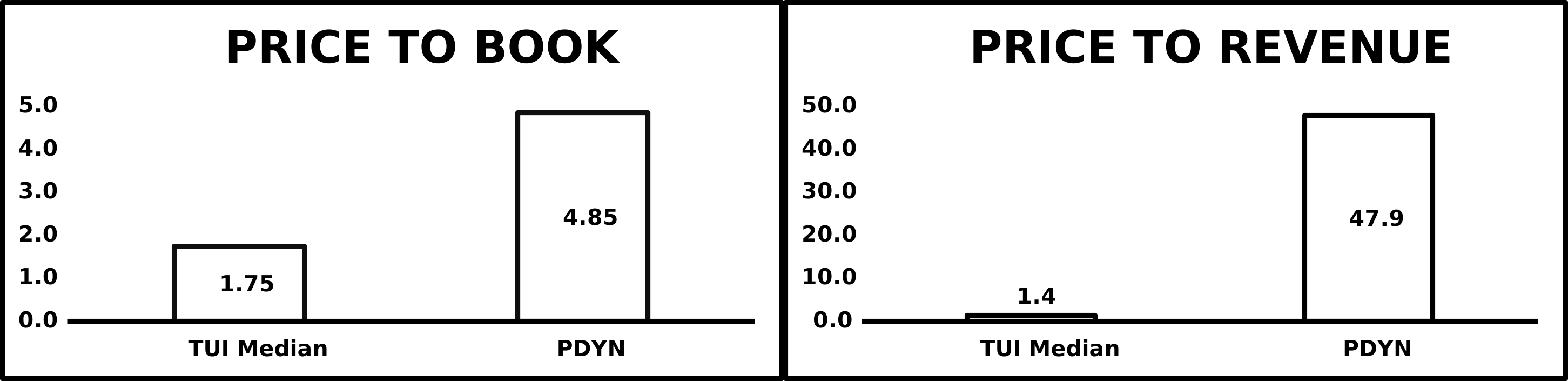
I didn't include price to earnings and price to cash flow here because TTM earnings and cash flow are negative for PDYN. The company's valuation is much higher than the median in the TUI index, relative to its revenue and book value. I expected this because the company is being valued based on its potential rather than its current performance. However, I still think it's important to look at these metrics to get an idea of how much the company will need to grow to be able to command a higher stock price in the future. For Palladyne's ratios to meet the current TUI median ratios, revenue would need to increase by 3,395% and book value would need to increase by 177%. This is an oversimplification, but in general, Palladyne's valuation tells me that the market expects the company to grow significantly. While this doesn't make it a bad investment, I do think it increases the risk that the market may punish the stock even if the company grows, but at a slower pace than anticipated.
In my view, the Palladyne AI stock has the following strengths and risks. First, I think the company has a lot of potential and their approach to creating technology that solves problems in the defense and manufacturing industries is compelling. I would encourage you to browse their website and read their posted whitepapers if you want to get more acquainted with this approach. Having made deals with significant players in the defense space like IAI gives their technology a level of third-party validation. They have great connections with the Department of War, winning many development contracts over the past few years. In addition, they have a healthy balance sheet that provides them with some time to execute their strategies without a financial squeeze. On the risk side, Palladyne currently has a high valuation relative to its fundamentals, showing that investors expect it to grow significantly. If it misses these growth expectations, the stock could stagnate or go down. In addition, the company did not find commercial success with its previous business model and has yet to with its current model. The stock price has historically had a lot of variability, with a beta of 3.51 and volatility of 102.92% over the past year. I am currently invested in this stock with over 5% of my portfolio. Going forward, I will be monitoring how they execute their ideas and use them to create a commercially viable business. I will reconsider my investment if I don't feel that progress is being made in this regard. Please don't take this article as investment advice - do your own research before making any investment decisions. Read my notes page for a description of my investment process.